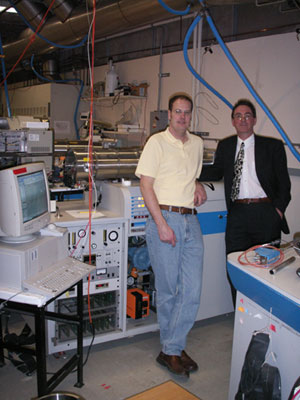
INSTRUMENT NAME: Sciex/MDS API III+ Triple Quadrupole Biomolecular Analyzers

INSTALLATION DATE: 1992, 2001, 2003, and 2006

OPERATOR: Kym Faull, Julian Whitelegge, Puneet Souda, Sara Bassilian, Andreas Breidbach, Andrew Norris, Arman Yaghoubian, and Frederic Halgand

SYNOPSIS: The Pasarow mass spectrometry laboratory is proud to have four operational PE-Sciex/MDS API III+ Biomolecular Analyzers. These extremely robust and reliable instruments are almost continuously in use for all different kinds of analysis. The first instrument arrived in our lab in 1992, a second was acquired in 2001 [generously donated by Selectide Corp.], the third in 2003 [generously donated by Genentech INC, see a section of this site dedicated to the trip to Genentech by clicking HERE!!], and the fourth in April 2006 [generously donated by Alta Labs, see a section of this site dedicated to the trip to Alta Labs by clicking HERE!!]. With a mass range of 10 to 2400 m/z and unit resolution, the "III+" triple quads still serve us faithfully. Cutting edge proteomics experiments are routinely carried out by Dr. Julian P. Whitelegge and others. Dr. Whitelegge’s LCMS+ technique was developed using one of the III+’s as the mass detector for the second round of chromatography. Dr. Whitelegge has also recently observed a 140kDa dimer by LC-ESI-MS, one of the largest intact proteins analyzed by ESI-QQQ methods. The atherosclerosis research group here at UCLA have discovered which lipids from an artery wall plaque are bio-active in promoting heart disease using the III+. The III+ plays a pivotal role in Dr. Kym Faull’s introduction to mass spectrometry class [C108/C208: Mass Spectrometry for Chemists and Biochemists, taught each winter quarter]. Students are introduced to electrospray theory, liquid chromatography, and quadrupole mass analysis theory by analyzing proteins, lipids, steroids, and nucleic acids. These robust instruments provide excellent teaching tools and are the center piece of the class.


PLEASE REFERENCE OUR LABORATORY IN ALL PUBLICATIONS USING DATA AQCUIRED ON THE SCIEX API III+s. THANK YOU!